
Imagine you're chatting with a friend. As they talk, you might nod, say "yeah", or add a quick "okay". These small, seemingly simple reactions — known as backchannel responses — help conversations feel natural and connected. They show you're listening and engaged, all without interrupting the speaker. While this kind of communication comes naturally to humans, it's a whole different story for machines.
Today's advanced AI systems, like ChatGPT, are great at responding once you're done talking. However, they're still missing something crucial in natural conversation: the ability to react in real time, like a person would. They don't yet know when to chime in with a quick acknowledgment or a well-timed "got it" while someone else is still speaking.
Why Timing Matters in Conversation
Good conversation isn't just about what you say. It also depends on when you say it. A delayed "yeah" or an early "I agree" can feel awkward or disrupt the flow. Humans use tone of voice, facial expressions, pauses, and body language to judge the right moment to speak or respond.
Most existing conversational AI models, however, don't have access to all these signals. They usually rely on a text-based pipeline. Spoken words are turned into text using speech recognition, processed by a language model, and then converted back into audio with text-to-speech. This process often misses important visual and audio cues that people naturally use in real conversations.
There's another issue too. AI models are mostly trained on written text — books and websites. Written language is more formal and structured, while real conversation is messy, fast, and filled with shared context.
A Smarter Way to Train AI to Listen and React
To solve this, we created a new approach to help AI learn not just what to speak, but also when to speak. We built conversational datasets using real conversation videos from public online platforms. This dataset includes video, audio, and text so the AI can learn from the full range of signals that humans use.
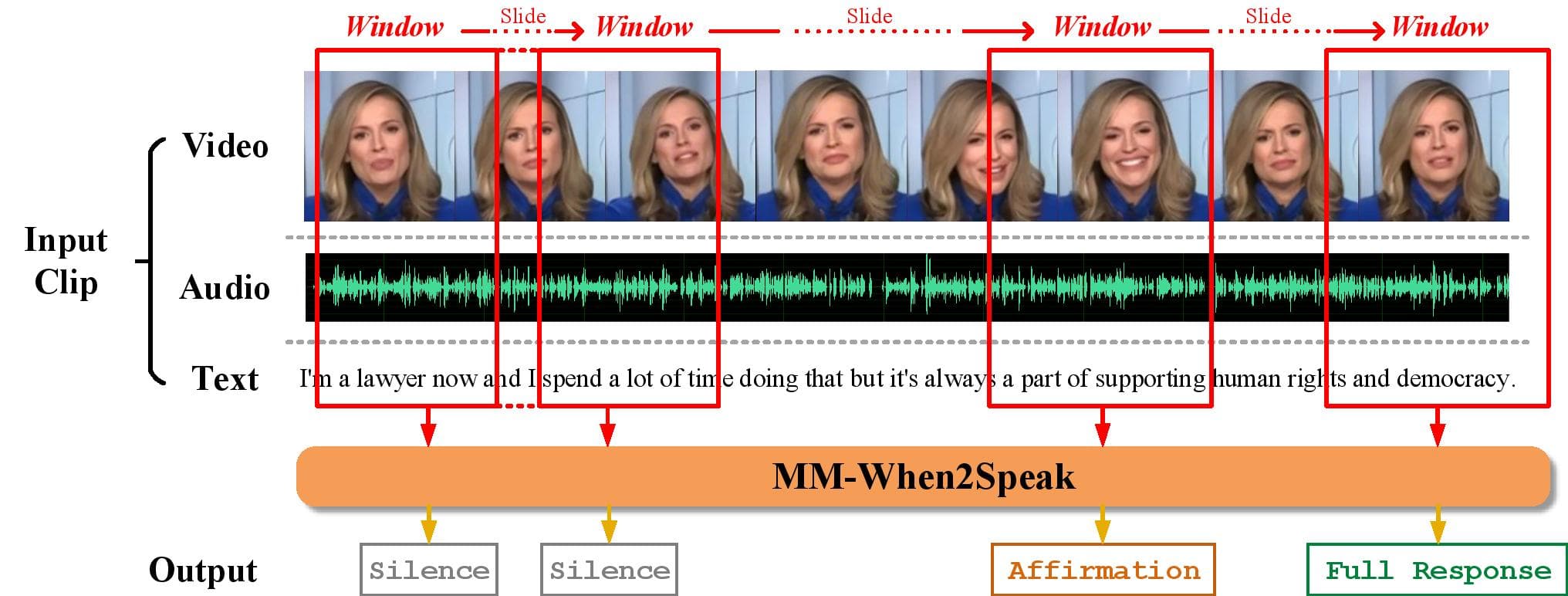
We processed each video into short clips and labeled each one as either silence (non-speaking), full response (start speaking), or one of several short reaction types — affirmations, greetings, expressions of surprise, and questions. This helps the AI understand different kinds of listener responses and the cues that lead up to them.
Knowing When to Speak — and When to React
Using this dataset, we developed MM-When2Speak[1], a new AI model that combines visual, audio, and textual information to decide if it should respond during a conversation, and what kind of response to give. At its core, each modality is first encoded separately, then concatenated and passed through self-attention layers, enabling the model to focus on the most relevant cues across time and modalities.
| Model | Silence F1 | Full Response F1 | Reaction F1 |
|---|---|---|---|
| Text-only LLM | 0.71 | 0.63 | 0.41 |
| Audio + Text | 0.78 | 0.71 | 0.53 |
| MM-When2Speak (ours) | 0.89 | 0.84 | 0.72 |
We tested MM-When2Speak against top large language models using different modality combinations. Our model consistently outperformed others, demonstrating the value of integrating visual, audio, and textual signals. This shows that going beyond text alone is essential for building AI that can engage in more natural, human-like conversations.
If we want AI to truly understand us and take part in our conversations the way people do, timing is everything. With MM-When2Speak, we are one step closer to making AI that not only knows what to say, but also knows the perfect moment to say it.
References
Try it
Experience natural AI conversation
Sign up in minutes. No download. Browser-based.